Read the full PDF: Click here to view the original document
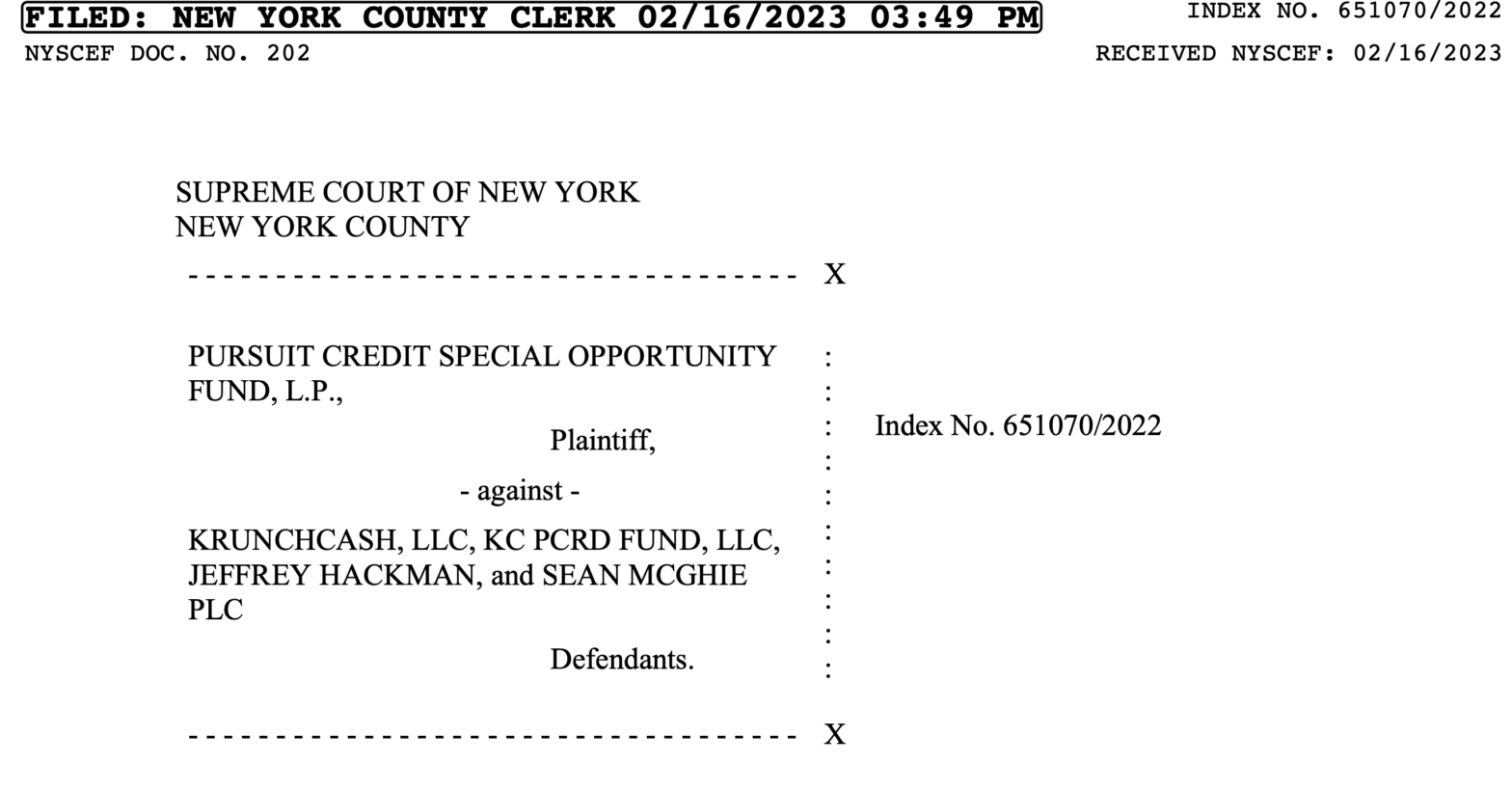
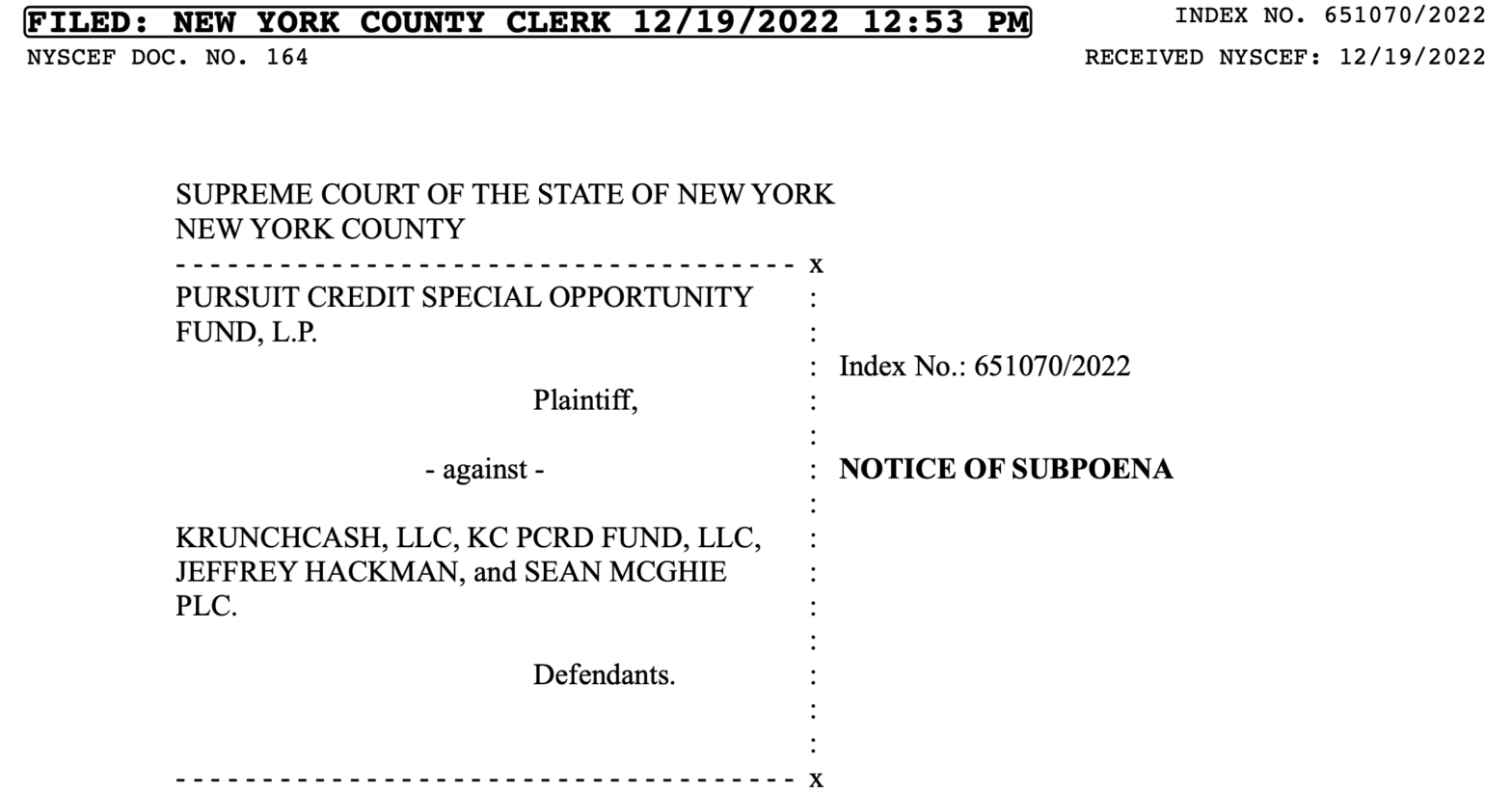
SUPREME COURT OF THE STATE OF NEW YORK
NEW YORK COUNTY
- – – – – – – – – – – – – – – – – – – – – – – – – – – – – – – – – – – – x
PURSUIT CREDIT SPECIAL OPPORTUNITY
FUND, L.P.,
Plaintiff, - against –
KRUNCHCASH, LLC, KC PCRD FUND, LLC,
KC CA FUND, LLC, and JEFFREY HACKMAN,
Defendants.
Index No. 651070/2022
RULE 19-a STATEMENT OF
MATERIAL FACTS - – – – – – – – – – – – – – – – – – – – – – – – – – – – – – – – – – – – x
Pursuant to Commercial Division Rule 19-a, Plaintiff Pursuit Credit Special Opportunity
Fund, L.P. submits the following material facts in the record:
A. Pursuit’s Arrangements with the KrunchCash Entities
- The KrunchCash Entities were specialty finance entities. (Cohen Aff. ¶¶ 2, 8, 107.)
- KrunchCash was an investor into legal funding assets, including law firm, plaintiff,
and medical lien funding, and advances backed by pharmaceutical receivables (“Advances”).
(Ex. 3 (KrunchCash Dep. 1/8/2025) at 13:01–16:25; 148:13–149:23; Ex. 1 at 49:14–51:16.) - Pursuit invested with KrunchCash and KC PCRD through 2021. (Cohen Aff. ¶¶ 2,
71-78, Ex. 3 at 13:01–16:25.) Pursuit invested into KrunchCash-related opportunities through
revenue-sharing arrangements wherein Pursuit would hold the right to revenues from particular
Advances. (Cohen Aff. ¶¶ 4-11, Ex. 3 at 14:20–15:6; 42:3–7.) - From 2015 through early-2018, Pursuit and KrunchCash were parties to an Investor
Funding Agreement dated April 2015 (the “Original IFA,” as amended) and a Purchase Agreement
dated September 2017. (Ex. 7 (Investor Funding Agreement dated 1/15/2015); Ex. 8 (Purchase
FILED: NEW YORK COUNTY CLERK 10/17/2025 05:34 PM INDEX NO. 651070/2022
NYSCEF DOC. NO. 814 RECEIVED NYSCEF: 10/17/2025
1 of 32
2
Agreement dated 9/29/2017); see also Ex. 1 at 26:9-27:4, 46:10-14 (authenticating Original IFA)
and 116:14-117:3, 117:18-118:9 (authenticating Purchase Agreement); Ex. 3 at 15:4–24.) - On April 10, 2018, Pursuit and KC PCRD entered into the Amended and Restated
Funding Agreement (the “Amended IFA”), which supplanted the Original IFA. (Ex. 9 (Amended
IFA dated 4/10/2018); see Ex. 1 43:7-44:22 (authenticating Amended IFA).) - The claims at issue here pertain to Pursuit’s investment from the date of the
Amended IFA through November 26, 2019 (the “Investment Period”). (Ex. 10 (Expert Report of
Graham Rogers dated 5/22/2025) ¶¶ 61–64.) - With the Amended IFA, KrunchCash created a new entity—KC PCRD—to hold
the monies that Pursuit invested. (Ex. 9; Ex. 1 at 22:13–18.) - The Amended IFA contemplates that KC PCRD would make Advances to and recollect monies from third-party Recipients. (See Ex. 9 § 3, Cohen Aff. ¶¶ 6-11.)
- In practice, KrunchCash would receive investor funds, route those funds back to
KC PCRD, and then KC PCRD would transfer monies back to KrunchCash. KrunchCash would
then make Advances and receive repayments from Advances from a KrunchCash account that
Hackman referred to as the “cash management account,” and KrunchCash would then remit
Pursuit’s portion of Advances back to KC PCRD. (See Ex. 1 at 65:16–68:21; Ex. 4 (KrunchCash
Dep. 1/9/2025) at 16:08–19:24; Cohen Aff. ¶¶ 8-9.) From the KC PCRD account, monies could
be distributed to Pursuit or, as was the case here, were consistently reinvested into additional
Advances. (See id.) - Paragraph 6 of the Amended IFA contains the waterfall pursuant to which Pursuit
and KC PCRD would split proceeds from Advances:
FILED: NEW YORK COUNTY CLERK 10/17/2025 05:34 PM INDEX NO. 651070/2022
NYSCEF DOC. NO. 814 RECEIVED NYSCEF: 10/17/2025
2 of 32
3 - Allocations and Disbursements. The proceeds from each
Advance provided with the Investor Funding will be allocated and
disbursed as follows:
(i) First, the amount repaid by the funding recipient will be
deposited into the Bank Account1 (“Repayment Amount”).
(ii) Second, the Advance will be deducted from the Repayment
Amount and left in the Bank Account to be re-advanced.
(iii) Third, the difference between the Repayment Amount and the
Advance (net of the Servicing Fee payable to Company pursuant to
Section 4) will be allocated and disbursed as follows: (A) Fifty
percent (50%) of the proceeds will be allocated and disbursed to
Investor; and (B) Fifty percent (50%) of the proceeds will be
allocated and disbursed to Company [KC PCRD]. Company will
disburse such proceeds no more than once per calendar month to the
extent of cash available.
(Ex. 9, Ex. 1 at 76:15–22.) - Thus, per Paragraph 6(i) of the Amended IFA, the “Repayment Amount,” i.e., the
principal advanced using Pursuit’s capital and repaid to KrunchCash, was to be repaid into the
dedicated KC PCRD bank account as a first step for safekeeping. (See id.) - Paragraph 6(iii) contemplates a profit-share, calculated as 50% of the “Repayment
Amount” minus the “Advance,” to Defendants. (Id., Cohen Aff. ¶¶ 10-11.) - There is no upfront “Servicing Fee” and the Amended IFA explicitly states that the
“Servicing Fee” is equal to “zero percent (0%)[.]” (Ex. 9 § 4, 6(iii).)
B. The Advances - Pursuit’s investments were supposedly tied to and backed by proceeds from the
underlying claims that served as collateral to KrunchCash’s Advances to third-party recipients
(“Recipients”). (Ex. 9 § 2, 3.)
1 The Amended IFA defines “Bank Account” as the KC PCRD account.
FILED: NEW YORK COUNTY CLERK 10/17/2025 05:34 PM INDEX NO. 651070/2022
NYSCEF DOC. NO. 814 RECEIVED NYSCEF: 10/17/2025
3 of 32
4 - Pursuit was granted a first-lien security interest in all proceeds from Advances it
funded, and KrunchCash agreed to assign all “right, title and interest” in all proceeds received
from Advances to KC PCRD for such purpose. (Id. § 7, 2.) - The “Resnick” or “Maryland” Advances were a series of Advances to related
personal injury firms The Law Offices of Jonathan S. Resnick LLC (owned by Jonathan Resnick)
and The Law Offices of Perry A. Resnick (owned by Perry Resnick, son of Jonathan Resnick), and
the Law Offices of Louis Glick (collectively the “Resnick Firms”). (Ex. 1 at 146:01-152:13.)
Additionally, there were Advances made to healthcare provider American Wellness Health Center
Inc., a medical provider to clients of the Resnick Firms (collectively, the “Maryland Firms”). (See
Ex. 1 at 52:11-17.) - Defendants represented that the Advances by KrunchCash to the Resnick Firms
were secured and repaid by a portion of each firm’s one-third contingency fee and entitlement to
recoup out-of-pocket expenses from underlying litigations. (See Ex. 1 at 29:07–21; 35:19–36:04,
52:02–53:19, Cohen Aff. ¶¶ 18-21.) The anticipated proceeds from the Resnick Firms’ injury cases
were under $20,000 per litigation and averaged around $5,000. (Ex. 1 at 150:05–20; Ex. 23 (Perry
Resnick Dep. 3/28/2024) 15:08-15.) The amount the Resnick Firms were entitled to receive as a
contingency fee was a percentage of the total proceeds, typically around 33 percent if no lawsuit
was filed, and 40 percent if an action was commenced. (Ex. 23, 15:21-16:05.) KrunchCash
purported to provide several forms of funding to the Resnick Firms including pre-settlement,
expense, post-settlement, and medical funding. (Ex. 11 (KrunchCash Funding Summary
10/12/2017), Ex. 1 at 150:05–162:17.) - Defendants represented that KrunchCash’s entitlement from the Resnick Firms was
the amount of the Advance—i.e., the principal funded to the firm—plus a “Use Fee.” (Ex. 1 at
FILED: NEW YORK COUNTY CLERK 10/17/2025 05:34 PM INDEX NO. 651070/2022
NYSCEF DOC. NO. 814 RECEIVED NYSCEF: 10/17/2025
4 of 32
5
217:8-17; 219:7-220:8, 35:19-36:4.) The “Use Fee” was an amount equal to 4% per month from
the time the monies were funded, subject to a six-month minimum equal to 24%. (See id.) At least,
these were the terms represented to Pursuit when Hackman described the nature of the Advances.
(Ex. 11.) - Thus, based on the waterfall described above, if KrunchCash successfully
recollected an Advance that had accrued a minimum six-month “Use Fee” then Pursuit would
receive 112%—equal to return of the Advance (100%) plus half of the Use Fee (12%)—and the
KrunchCash Entities would receive 12%—equal to the other 50% of the Use Fee. (Ex. 1 at 29:7–
21, 219:7–220:8, 164:5–165:4, 242:18–243:5; 294:4–295:9, Cohen Aff. ¶ 22.) - The “LB Pharma” Advances were monies KrunchCash funded to a Texas-based
pharmaceutical business, LB Pharma and its affiliates. (Ex. 1 at 52:18–24; Ex. 3 at 14:1–19, Ex.
12 (Email Hackman to Pursuit 10/25/2018).) Defendants represented that the receivables to
LB Pharma were adjudicated pharmaceutical insurance claims that would be expected to pay off
in 30-45 or 45-60 days. (Cohen Aff. ¶¶ 23-25, Ex. 12, Ex. 3 at 57:8–17, 69:16–70:4, 162:12–25,
164:3–7, 165:1–3.) - Pertinently, Pursuit also provided $872,000 in capital to Defendants to advance to
a Connecticut-based law firm, Berkowitz Hanna LLC (“BH”), secured by that firm’s receivables.
(See Ex. 4 at 259:24–261:19.) - KrunchCash claimed to have invested in other Advances, unrelated to Pursuit, such
as Advances secured by ex-NFL players’ recoveries from the litigation against the NFL (the “NFL
Advances”). (Ex. 4 at 189:2-4; Ex. 1 at 42:24–43:6, Ex. 4 at 189:2–4.) Defendants refused,
however, to produce information to substantiate other Advances. (Docs. 655, 735, 717 (Motion
Seq. 18).)
FILED: NEW YORK COUNTY CLERK 10/17/2025 05:34 PM INDEX NO. 651070/2022
NYSCEF DOC. NO. 814 RECEIVED NYSCEF: 10/17/2025
5 of 32
6
C. Defendants’ Representations Concerning the Advances and Ledgers - Hackman shared with Pursuit a spreadsheet “Ledger” that Hackman manually
created and maintained on Microsoft Excel. (See Ex. 1 83:16–88:2, Ex. 4 at 106:12–17; 156:16–
22; 157:16–23, Cohen Aff. ¶¶ 29-33, Ex. 13 (Pursuit Ledger).) Hackman had a trusting relationship
with Pursuit’s manager, Mitchell Cohen (“Cohen”). (Cohen Aff. ¶ 27.) The two spoke multiple
times weekly concerning the Advances, and Hackman attempted to befriend Cohen. (See id. ¶¶
27-30.) - The Ledger reflected the supposed balances and performance of the Advances on
an overall and claim-by-claim (i.e., plaintiff-by-plaintiff) level. (Ex. 1 at 83:16–88:2; Ex. 4 at
100:2–102:19.) The Ledgers then tabulate the monies invested by Pursuit into the KrunchCash
Entities, supposedly funded by KrunchCash to the end-Recipients using Pursuit’s capital, and
supposedly collected, along with the “Use Fee”, from Recipients. (Ex. 1 83:16–88:2, Ex. 4 at
106:12–17, 200:12–202:16 (the parties “relied” on the Ledger to monitor performance).) The
Ledger then tracks the “waterfall” and presents calculations of Pursuit’s investment balance and
Defendants’ profit-share. (Ex. 1 83:16–88:2, See Ex. 13, Ex. 1 at 71:12–77:2, 83:16-88:2, 132:8–
133:14, Ex. 4 at 100:2–106:17.) The Ledgers also provided various performance-related data
concerning the Advances, including the date of funding, date of repayment, and duration of each
claim. (Ex. 1 at 83:7–24.) - Hackman shared the Ledger live through a cloud account. (Ex. 1 at 84:19–85:3,
231:23–234:25.) Though the Ledger was cloud-based, Pursuit’s principals would periodically
download and date-lock the Ledger for internal record-keeping purposes. (Cohen Aff. ¶ 29, Ex.
13.)
FILED: NEW YORK COUNTY CLERK 10/17/2025 05:34 PM INDEX NO. 651070/2022
NYSCEF DOC. NO. 814 RECEIVED NYSCEF: 10/17/2025
6 of 32
7 - Hackman and the KrunchCash Entities represented, in the Ledger and throughout
Pursuit’s investment and reinvestment, information concerning the Resnick Advances. (Ex. 1 at
231:23–234:25.) Such representations included that:
- Each Advance on the Ledger reflected new monies that KrunchCash
actually advanced to the Recipient in cash based on the Recipient’s new
need for monies. (Ex. 1 at 231:23–234:25, 225:23–226:16.) The Ledger
represented that, during the Investment Period, KrunchCash advanced over
$45 million to the Maryland Recipients. (Ex. 13, at Tabs LAW.LG,
LAW.PR, PIP, Post, and LOP (sum of “Gross” amounts funded on or after
Apr. 10, 2018); Ex. 4 at 106:9–11 (over $63 million over time).) - Claims reflecting “collected” values on the Ledger were successfully repaid
by the Maryland Recipients from settlement proceeds. (Ex. 10 ¶ 31.)2 The
Ledgers reflected that, during the Investment Period, the Maryland
Recipients repaid $7.2 million to KrunchCash. (Id. ¶ 158.) - When Pursuit dedicated capital to a particular Advance, each of the claims
within that Advance was unencumbered, such that Pursuit was the only
investor with an interest in that receivable. (Cohen Aff. ¶ 34, Ex. 9 § 2, 7;
Ex. 1 at 29:7–21, 35:19–36:4).) - Each Advance was collateralized 2-to-1, meaning that for each “claim”
backing an Advance, there was another unencumbered claim handled by the
Resnick Firm that could serve as replacement collateral. (See Ex. 2 at
472:2–6, Cohen Aff. ¶ 34, Ex. 1 at 29:7–21, 35:19–36:4.) This gave Pursuit
comfort that there was value in the Resnick Firms beyond the claims that it
was funding. (Cohen Aff. ¶ 34.)
- Defendants also made representations concerning the LB Pharma Advances, which
included that:
- The Advances were being made to pharmacies that held portfolios of
adjudicated—i.e., resolved—reimbursement claims that would be repaid
within 30-45 or 45-60 days. (See Ex. 3 at 18:6–24, Ex. 4 at 162:12–25,
164:3–165:3; 69:16–70:4, Ex. 12.)
2 There is one exception wherein, in the month prior to execution of the Amended IFA,
Pursuit permitted Hackman to sell one portfolio of receivables to which Pursuit had an interest to
another then-unknown investor for $1 million. (Cohen Aff. ¶ 34.)
FILED: NEW YORK COUNTY CLERK 10/17/2025 05:34 PM INDEX NO. 651070/2022
NYSCEF DOC. NO. 814 RECEIVED NYSCEF: 10/17/2025
7 of 32
8 - Advances were being repaid on a timely basis—i.e., each “tranche” and
“claim” within than tranche—was repaid profitably from insurance
proceeds. (Ex. 4 at 161:17–19.) - When Pursuit dedicated funding to an LB Pharma Advance, KrunchCash
was actually funding such amounts to LB Pharma in cash. (Ex. 14–16 (Text
Messages Hackman and Cohen 9/9/2018, Text Messages Hackman and
Cohen 8/22/2018, Text Messages Hackman and Cohen 10/19/2018).) The
Ledger represented that more than $41 million had been advanced to LB
Pharma. (Ex. 4 at 105:20–106:11 (Q: Does the $41 million represent actual
funds out to the advance recipient? A: Yes.).) - LB Pharma had repaid approximately $35.5 million in total before
defaulting. (Ex. 13, TAB “RX” (showing amounts “Collected”).)
- Hackman provided read-only access to Pursuit to the bank account held in the name
of KC PCRD. (Cohen Aff. ¶ 36.) Each time that he reflected claims as “collected” on the Ledger,
Hackman moved monies to the KC PCRD account to mirror such transactions—thus giving the
illusion that cash was being collected. (Id., Compare Ex. 13 (Ledger) at “Register” Tab with Ex.
35-1 (Bank Statement).) But, as discussed below, Pursuit is now aware that the cash that Hackman
temporarily deposited into the KC PCRD account, and which Hackman quickly transferred back
to KrunchCash for supposed reinvestment, was not cash actually received from the end-Recipients.
(Ex. 10.) - Hackman testified he had unfettered authority, power, and discretion to invest
Pursuit’s capital however he wished. (Ex. 1 at 39:32–42:23.) Pursuit did not need to agree on how
funds would be reinvested “because Pursuit had no input on the business per the agreement. No
participation.” (Ex. 1 at 74:5–75:7.) There were “no limits” on Hackman’s latitude, including
theoretically, gambling Pursuit’s money in Las Vegas. (Ex. 1 at 74:5–75:7, 108:18–109:16.) - Pursuit invested and reinvested based on Hackman’s representations in the Ledgers
and otherwise as to the nature of the Advances and Defendants stewardship of Pursuit’s funds. As
of the date of the Amended IFA, Pursuit had invested $2.8 million with KrunchCash. (Ex. 9 § 1,
FILED: NEW YORK COUNTY CLERK 10/17/2025 05:34 PM INDEX NO. 651070/2022
NYSCEF DOC. NO. 814 RECEIVED NYSCEF: 10/17/2025
8 of 32
9
Ex. 13, Ex. 10 ¶¶ 21.) Following execution of the Amended IFA, Pursuit invested an additional
$8.2 million—bringing Pursuit’s total investment to approximately $11 million. (Ex. 9 § 1, Ex. 13,
Ex. 10 ¶¶ 192.) Hackman made some distributions to Pursuit—which Pursuit now understands to
have been false-profit distributions—such that Pursuit’s net out-of-pocket investment was $7.16
million. (Ex. 9 § 1, Ex. 13, Ex. 10 ¶¶ 191-192.) - Based on the represented success of the LB Pharma Advances, specifically, Pursuit
invested approximately $8 million in new cash into KC PCRD for LB Pharma between July 2018
and April 2019. (Cohen Aff. ¶ 40; Ex. 10 ¶ 187.) In the summer and fall of 2018, Hackman spent
considerable effort inducing Pursuit to invest additional capital. (Cohen Aff. ¶¶ 41-45; Ex. 1 at
334:13-336:4; Ex. 38 (Text Messages 8/22/2018); Ex. 14; Ex. 15; Ex. 16.) Hackman travelled to
New York and met with Pursuit’s two managers and one of its limited partners to solicit new
investment. (Cohen Aff. ¶ 41; Fergang Aff. ¶¶ 8-9, Ex. 1 at 334:13-336:4, Ex. 38, Ex. 14, Ex. 16.)
Hackman represented that the LB Pharma opportunity required nearly $4 million in new cash
funding based and warned that, if Pursuit did not act quickly, another investor might seize the
opportunity. (Cohen Aff. ¶¶ 41-45; Ex. 1 at 334:13-336:4); Ex. 38 (“Need a large commitment
from [substantial investor] so [Pursuit] can stay in the game[.]”); Ex. 14 (affirming that LB Pharma
was seeking $3.3 million and “it is going to get bigger every week thereafter” and that Hackman
“need[ed] the investors to keep up with me”); Ex. 16.) When Pursuit’s limited partner, enthralled
by the false returns that Hackman had been indicating on paper, inquired if Hackman could scale
his Advances, Hackman responded that LB Pharma had endless inventory that KrunchCash could
fund, limited only by Pursuit’s willingness to invest new capital. (Fergang Aff. ¶¶ 10-16, Cohen
Aff. ¶¶ 42-46.) Based on such representations, Pursuit wired a new tranche of $3.25 million in
FILED: NEW YORK COUNTY CLERK 10/17/2025 05:34 PM INDEX NO. 651070/2022
NYSCEF DOC. NO. 814 RECEIVED NYSCEF: 10/17/2025
9 of 32
10
cash, adding to the other monies Pursuit had already invested in LB Pharma. (Ex. 1 at 334:13-
336:4).) - As of December 31, 2018, Pursuit’s investment balance as reflected on the Ledger
was $9.5 million. (Ex. 17 (Email Hackman to Pursuit 6/4/2019) (“As of 12.31.18 PCRD investor
funding account balance was $9,510,000.”); Ex. 4 at 183:1–183:10.) - The Ledgers represented that, based on KrunchCash’s supposed successful
recoveries from Advances, that they were entitled to $2,935,060.88 in profit-share compensation
during the Investment Period. (Ex. 13.) - Hackman also issued bulk advances to the Maryland Recipients for “litigation
expenses” and advances supposedly backed by “Letters of Protection”, however there are no
corresponding transfers to the Maryland Recipients evidencing this. (Compare Ex. 13 (Ledger) at
“LOP” Tab (representing $300,000 purportedly advanced against Letters of Protection for 1500
cases on 5/11/2018) and Ex. 34 (Signal Ledger) at “EXP” Tab (representing $300,000 purportedly
advanced for medical expenses against 1000 cases on 5/11/2018) with Ex. 35-2 (KrunchCash Bank
Statements) May 2018 at pp. 153-155 (showing no corresponding KrunchCash advance to the
Maryland Recipients on or around 5/11/2018, but a transfer from KC-PCRD’s account to
KrunchCash of $300,000 on 5/15/2018). According to the Ledger, $1.1 million in “bulk” advances
were funded using Pursuit’s investment capital, and another $2.6 million in “bulk” advances were
either funded or purchased using Signal Fund’s investment capital, each time without a
corresponding transfer to the Maryland Recipients. (See Ex. 13 (Ledger) at “LOP” Tab, F:5 and
Ex. 34 (Signal Ledger) at “EXP” and “MED” Tabs, F:7; see generally Ex. 35-2 (KrunchCash’s
Bank Statements).)
FILED: NEW YORK COUNTY CLERK 10/17/2025 05:34 PM INDEX NO. 651070/2022
NYSCEF DOC. NO. 814 RECEIVED NYSCEF: 10/17/2025
10 of 32
11
D. The Default Actions and Discovery of Other Investors - In 2019, matter shifted. Pursuit attempted to redeem some of its capital, but
Hackman denied Pursuit such right. (Ex. 18 (Email Hackman to Pursuit 6/4/2019); Ex. 19 (Email
Cohen to Hackman 8/8/2019).) - In mid-2019, Pursuit also attempted to conduct a financial “review” of Pursuit’s
investment, so that Pursuit could substantiate the supposed success of its investment as set forth in
the Ledgers. (Ex. 20 (Email Hackman to Pursuit 11/13/2019), Ex. 4 at 183:21–186:19.) Pursuit
was unable to do so because, when Pursuit’s outside accountant sought access to bank records for
the “cash management” account in the name of KrunchCash—to tie out actual cash flows between
KrunchCash and the Advance recipients—Hackman refused to provide sufficient data. (Ex. 20;
Ex. 4 at 183:21–186:19; Doc. 110 (Parzygnat Affidavit) ¶¶ 4-6.) No review was ever completed
on Pursuit’s investments (or the KrunchCash Entities, which was never the subject of the review
in any event) because KrunchCash would not provide such records. (See id.) While Pursuit had
access to the KC PCRD bank statements, until such records were compelled through discovery in
this action, Pursuit never possessed KrunchCash’s bank statements. (Cohen Aff. ¶ 55.) - Instead, Hackman revealed that KrunchCash had become a party to various
litigations with the Resnick Firms and with LB Pharma (the “Default Actions”). (Ex. 3 at 84:2–8.)
The Default Actions sparked new issues among the parties. - Hackman explained that that Resnick Firms had abruptly stopped making
repayments to KrunchCash, and insisted that the Resnicks—Jonathan Resnick, in particular—had
stolen millions that KrunchCash had funded. (Ex. 21 (Hough Dep. 6/7/2024) at 162:19–163:24.)
Hackman could not explain, however, where Jonathan Resnick supposedly directed these monies.
(Ex. 21 at 210:7–212:13; Ex. 29 (Overview of Resnick Default Actions to Signal); Ex. 30
(Overview of Resnick Default Actions to Pursuit).) Hackman claimed that there were thousands
FILED: NEW YORK COUNTY CLERK 10/17/2025 05:34 PM INDEX NO. 651070/2022
NYSCEF DOC. NO. 814 RECEIVED NYSCEF: 10/17/2025
11 of 32
12
of missing files at the Resnick Firms that could not be located. (Ex. 29; Ex. 30.) Though Hackman
initially suppressed such facts from Pursuit, the Recipients asserted—and maintain today—that
Hackman falsely inflated the amounts funded to the Recipients. (See Ex. 22 (Jonathan Resnick
Dep. 3/27/2024) at 146:1-147-5, Ex. 23 at 50:2-21.) - With respect to LB Pharma, Hackman explained that LB Pharma was entangled in
a convoluted audit and that repayments would resume once LB Pharma surpassed the obstacle.
(Cohen Aff. ¶ 59.) - Initially, Defendants aggressively pressed Pursuit to invest new extra-contractual
capital to support legal fees and KrunchCash’s operational expenses—including compensation to
Hackman—as the Default Actions progressed. (Ex. 2 at 487:9–18.) - Through these discussions, Defendants divulged that there were in fact (at least)
three investors—Pursuit, Signal Funding LLC (“Signal”), and KrunchCash (purportedly using
KrunchCash’s capital)—that had invested alongside one another into the Resnick Advances.
(Ex. 21 at 158:15–161:19; Ex. 24 (Email Hackman to Pursuit 4/1/2020) (“As discussed, there are
3 investors who have provided funding to the Resnicks, and 2 investors who have provided funding
to LB Pharma.”).) Hackman insisted that each of Pursuit and Signal contribute additional capital
to support the Default Actions, falsely stating that the other investor had already funded. (Ex. 21
at 216:17-217:10; Ex. 24.) - This was a red flag. Neither investor knew that the other had invested in the same
Advances. (Ex. 21 at 90:9-15, 109:18-112:9, 158:15–161:19, 151:23–152:24, 114:10–13, 78:4–9;
Cohen Aff. ¶¶ 61-65.) Pursuit and Signal each sought clarification as to how proceeds from the
Advances and/or Default Actions would be reconciled and distributed—as between three intercreditors—were they to be received. (Ex. 27, Ex. 21 at 124:11-125:22, 206:17-210:3; 124:11-
FILED: NEW YORK COUNTY CLERK 10/17/2025 05:34 PM INDEX NO. 651070/2022
NYSCEF DOC. NO. 814 RECEIVED NYSCEF: 10/17/2025
12 of 32
13
125:22; Cohen Aff. ¶ 64.) Each questioned how the Advances could realistically be parsed or
prioritized. (Id.) When Pursuit attempted to contact Signal to discuss these issues, Hackman lashed
out and threatened to sue Pursuit based on nonsensical confidentiality concerns. (Ex. 56.) The
revelation of three inter-creditors suggests irreconcilable competing liens over the same
collateral—i.e., double-pledging. (Ex. 10.) - Defendants’ representations about the Default Actions and multiple intercreditor
issues raised deepened red flags concerning the monies KrunchCash had funded to the Resnick
Firms. The Pursuit Ledger stated that, immediately prior to the Resnick Firms’ purported breach,
KrunchCash had outstanding Advances of approximately, $4.1 million (and $45 million funded
over the Investment Period), an amount that could have reasonably substantiated the coverage
ratios Pursuit understood to exist. (Ex. 13; Ex. 10 ¶¶ 34, 67, 97.) However, Hackman now claimed
that Signal and Hackman had an outstanding additional $13 million to the Resnick Firms—above
Pursuit’s amount—such that the total amount invested was $17.5 million. (Ex. 25 (Email Hackman
to Pursuit 3/20/2020).) By all accounts, Hackman’s representation of 2-to-1 collateralization was
false, and neither Pursuit nor Signal could have a first lien to the same receivables. - Likewise, contrary to Defendants’ representation that Pursuit was the only investor
in LB Pharma, Hackman also divulged that there was an additional investor in LB Pharma, thus
creating an irreconcilable double-pledging of the LB Pharma proceeds, as well. (Ex. 26 (Email
Hackman to Pursuit 3/20/2020).) - In April 2021, Pursuit sent a demand letter, seeking to satisfy the foregoing
concerns, so that Pursuit could continue protecting its investment with ample guardrails. (Ex. 27
(Ltr. Pursuit to Hackman 4/16/2021).) Defendants responded with a scathing attack. (Ex. 28 (Ltr.
Defendants to Pursuit 5/8/2021).) Instead of answering Pursuit’s request for an accounting,
FILED: NEW YORK COUNTY CLERK 10/17/2025 05:34 PM INDEX NO. 651070/2022
NYSCEF DOC. NO. 814 RECEIVED NYSCEF: 10/17/2025
13 of 32
14
Defendants gaslit Pursuit. (See id.) Because neither Pursuit nor Signal had access to the
KrunchCash bank account records—from which Hackman made and collected the Advances—
neither investor could verify the monies funded or owed. (Ex. 21 at 139:18–140:2, 145:22–146:10,
148:9–149:6.) Nor did Pursuit or Signal have access to the other’s Ledger showing the claims to
which each had an interest. (Ex. 1 at 272:24–273:8.) - Defendants became increasingly aggressive. After originally explaining that to
Pursuit that the Resnick Firms and LB Pharma owed and had stolen millions—and that Pursuit
should invest to protect such investment—Defendants threatened to scuttle the Default Actions in
bad faith if Pursuit did not capitulate. (Ex. 20; Ex. 24; Ex. 26; Ex. 30; Ex. 25.) - As Pursuit pressed, Pursuit learned that Defendants had been collecting and
intercepting receivables in which Pursuit had an interest. Defendants refused to turn over
approximately $270,000 from the BH Advance (Ex. 1 at 258:10–268:25, Ex. 31 (Ltr. to Pursuit
1/11/2022)) and refused to pay $275,000 indisputably owed on unrelated Advances. (Ex. 18.)
Defendants admitted Hackman had collected monies throughout the Default Actions, including
approximately $700,0003 by intercepting funds from an LB Pharma insurance payor (EPIC) and
approximately $2.5 million in additional collections from the Resnick Firms, but Hackman refused
to fully pay over such funds to Pursuit. (Ex. 32 (Payment EPIQ to KrunchCash 1/16/2020).)
Instead, Defendants began claiming that Pursuit waived its right to any proceeds based on their
refusal to blindly fund more monies to Defendants. (See Ex. 1 at 99:5–100:23.)
3 Upon learning that KrunchCash had intercepted these funds, Pursuit was able to negotiate a
partial repayment from the $700,000 intercepted from EPIC. (Cohen Aff. ¶ 75.)
FILED: NEW YORK COUNTY CLERK 10/17/2025 05:34 PM INDEX NO. 651070/2022
NYSCEF DOC. NO. 814 RECEIVED NYSCEF: 10/17/2025
14 of 32
15 - Ultimately, Hackman cut off Pursuit’s and Signal’s access to the shared cloud
accounts, the Ledgers, and the accounts to each investor’s dedicated entity (KC PCRD or KC SF).
(Ex. 21 at 33:3–35:22, 137:6–139:17, Cohen Aff. ¶¶ 77-78.)
E. Rogers’ Early Identification of Churning, Double-Pledging, and Siphoning of Funds
to KC CA - Early in this action, Pursuit and counsel engaged Graham Rogers of Eisner
Advisors Group, LLC (“Rogers”) to examine Defendants’ records. (Doc. 91.) - Rogers analyzed available data, including the Pursuit Ledger and the ledger that
Defendants provided to Signal (the “Signal Ledger”), which Signal produced in discovery. (Ex. 10
¶¶ 42, Ex. 34 (Signal Ledger); see Ex. 21 at 125:23-126:21 (authenticating Signal Ledger).) Rogers
observed substantial overlap between the claims listed on the Pursuit and Signal Ledgers,
indicative of churning and double pledging. (See id. ¶¶ 121-125, 147-164.) Specifically, there was
a pattern wherein:
First, KrunchCash sold proceeds from one Advance to Pursuit and
reflected the principal and “Use Fee” charged to the Resnick Firm
on the Pursuit Ledger. For example, the Pursuit Ledger would reflect
an $800 Advance plus a $192 minimum repayment amount, which
included the embedded (24%) “Use Fee.”
Second, KrunchCash would sell that claim from the Pursuit Ledger
to the Signal Ledger and reflect the Pursuit Ledger as paid off in the
“collected” column. This gave Pursuit the impression that a claim
was successfully repaid by the Resnick Firm and triggered
KrunchCash’s entitlement to 50% of profit share. But, in fact, the
claim was being sold from one ledger to the other without any actual
cash flow from the Resnick Firm.
In this step, the Signal Ledger would reflect an artificially increased
Advance amount above the $992 (e.g. $1,000) although, as is now
clear, there is no evidence that additional monies were funded to the
Resnick Firm. The Signal Ledger would then reflect a minimum
repayment amount that embedded an additional 24% “Use Fee”
(e.g. $1,240) supposedly owed by the Resnick Firms.
FILED: NEW YORK COUNTY CLERK 10/17/2025 05:34 PM INDEX NO. 651070/2022
NYSCEF DOC. NO. 814 RECEIVED NYSCEF: 10/17/2025
15 of 32
16
Third, KrunchCash would then engage in a third similar transaction
following the pattern above, reflecting the same false resolution of
the claim on Signal’s Ledger, and a corresponding artificial increase
in lending basis to the Resnick Firm as the claim was transferred to
Pursuit’s Ledger as a post-settlement Advance. As discussed below,
this third transaction often occurred after the underlying personal
injury lawsuit had resolved.
(Id. ¶¶ 123-124.) - The Court granted Pursuit’s motion to compel access to KrunchCash’s and KC
PCRD’s records at First Citizens Bank. (Doc. 115.) - Rogers’ early analysis of those records indicated that Defendants had
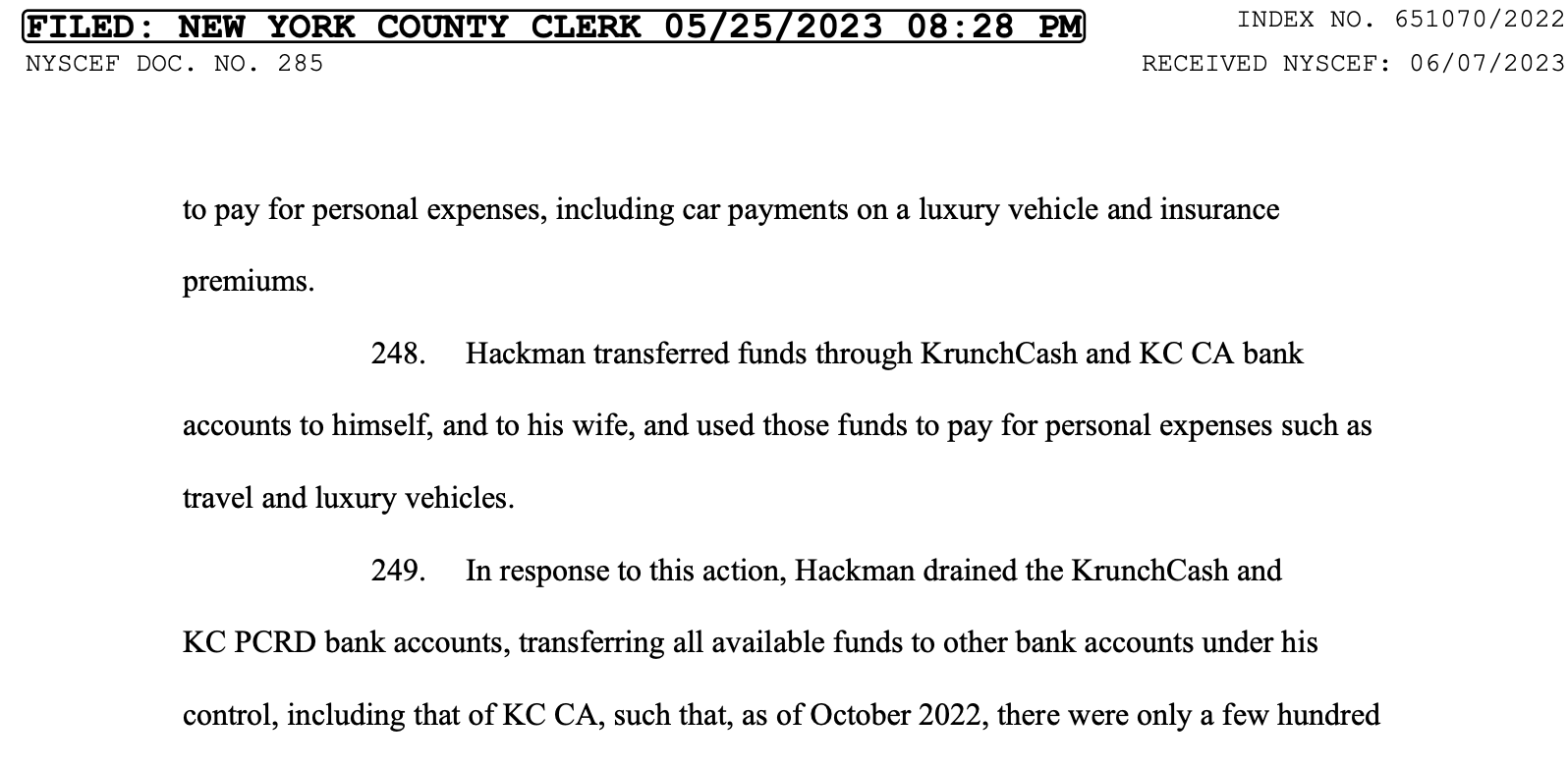
surreptitiously transferred over $5 million to KC CA, another Hackman entity. (Doc. 214.)
Hackman resisted production of the KC CA records, but explained that he was entitled to use such
proceeds because such account was a repository for his profits. (Ex. 33 (KC CA Interrogatory
R&O 7/31/2023); Ex. 1 at 76:22–79:21.) Pursuit ultimately obtained such records, which Rogers
then analyzed.
F. Rogers’ Final Report Demonstrates Fraud - In May 2025, Rogers submitted his final report. (See Ex. 10.) In addition to
analyzing the KrunchCash Entities’ bank statements and the Ledgers, Rogers analyzed “Settlement
Sheets” shared by the Resnick Firms with Hackman which showed each law client’s settlement,
date of accident, date of resolution, and the distribution proceeds, which Pursuit obtained in
litigation. (See id. ¶¶ 42, Exs. 35-1–35-7 (Bank Statements), Ex. 36-1–36-5 (Compilation of
Settlement Sheets).) Rogers conducted (1) a “Transaction Reconstruction” to normalize and
analyze the bank statements, (2) a “Forensic Analysis” to determine whether Defendants’ data met
forensic patterns of a Ponzi scheme, false entries, churning, double-pledging, and other fraud, and
(3) calculations of damages. (See id. ¶¶ 45-100, 111-189, 190-198.)
FILED: NEW YORK COUNTY CLERK 10/17/2025 05:34 PM INDEX NO. 651070/2022
NYSCEF DOC. NO. 814 RECEIVED NYSCEF: 10/17/2025
16 of 32
17
G. The Transaction Reconstruction Demonstrates Commingling, Misappropriation,
Use of Investor Funds for Personal Purposes, Missing Monies for Advances, and
that New Investors’ Monies were Used to Satisfy Debts to Previous Investors - In the Transaction Reconstruction, Rogers analyzed bank accounts in the name of
KrunchCash, KC PCRD, KC CA, and KC SF Fund LLC (“KC SF,” the entity Hackman devised
for Signal). (See id. ¶¶ 47-59.) Hackman confirmed that no bank accounts other than those
analyzed by Rogers, including the KrunchCash cash management account, were used to fund
advances sent to LB Pharma or the Maryland Recipients and that all relevant funds were tracked
through KC PCRD’s bank statements and the KrunchCash cash management account statements.
(Ex. 1 (KC CPRD Dep. 7/17/2024) at 347:18–348:10.)
i. Investor Funds – Inflows and Outflow - Rogers determined that three investors—Pursuit, Signal, and 1939 Capital, LLC
(“1939”)—invested during the “Investment Period.” (See id. ¶¶ 61-64.) Collectively, those
investors funded $14.65 million into the KrunchCash Entities, and $5.11 million was returned to
investors, for a net of $9.536 million invested. (Id. ¶¶ 62-63.) Additionally, as of the date of the
Amended IFA, Pursuit had a balance of $2.8 million and, one month prior, Signal invested $1.48
million. (See id. ¶¶ 63.) Thus, there was nearly $14 million of net new capital injected into the
KrunchCash Entities during the Investment Period. (See id.)
ii. Payments to Previous Investors - During the same period, in addition to remitting approximately $5.11 million to
present investors, the KrunchCash Entities remitted several million dollars to at least three prior
investors. (See id. ¶¶ 65-66.)4
4 Hackman repaid in excess of $5 million to prior investors during and immediately prior to the
Investment Period. (Ex. 10 ¶ 65, n.56.) Like Pursuit, Hackman owes millions in unpaid
receivables and cut off transparency. (E.g., Ex. 54 (Email with Xynergy 1/14/2025).)
FILED: NEW YORK COUNTY CLERK 10/17/2025 05:34 PM INDEX NO. 651070/2022
NYSCEF DOC. NO. 814 RECEIVED NYSCEF: 10/17/2025
17 of 32
18
iii. Commingling/Transfer of Investor Funds - Rogers determined that although Pursuit, Signal, and 1939 had its own Hackmanowned entity—KC PCRD, KC SF, and KC 1939—Hackman commingled the vast majority of
monies in the account in the name of KrunchCash, and not in the investor entities. (See id. ¶¶ 67-
72.) Monies were momentarily moved to the special-entity account (KC PCRD, in the case of
Pursuit)—to give the illusion that of repayments and profits—but those monies did not correspond
to actual repayments and Hackman immediately transferred such funds back to the KrunchCash
account. (See id.)
iv. Misappropriation of Investor Funds - Rogers determined that Defendants used investor funding for non-Advance
purposes. (See id. ¶¶ 73-88.) The Amended IFA provides that Pursuit’s monies were only to
“provide Advances,” (Ex. 9 § 2, 5, 6), that Defendants’ compensation was the 50% profit-split (id.
§ 5-6), and that the “Servicing Fee” was “zero.” (Id. § 4.) Thus, the only monies legitimately
available to fund Defendants’ operations were profit-shares from Advances or Defendants’ own
capital. - Rogers analyzed (1) the amounts Defendants deployed on uses other than
Advances, such as non-Advance overhead of KrunchCash or Hackman’s personal expenses, and
(2) compared those figures to potential legitimate sources of funds. (Ex. 10 ¶¶ 76-77.) - Legitimate sources of capital include legitimate profit-shares from Advances and
independent retained capital. (Id. ¶¶ 80-81.) The cash across the KrunchCash Entities as of the
Amended IFA date was $1.1 million, which Rogers conservatively assumed to be the maximum
retained earnings (although there is evidence that there were no retained earnings at all). (See id.
¶¶ 81.)
FILED: NEW YORK COUNTY CLERK 10/17/2025 05:34 PM INDEX NO. 651070/2022
NYSCEF DOC. NO. 814 RECEIVED NYSCEF: 10/17/2025
18 of 32
19 - As for Advance profits, during the Investment Period, there was a net outflow of
$1.62 million from the KrunchCash Entities to the Maryland Recipients and a net outflow of
$4.947 million across all Advances; thus there were no cash profits. (See id. ¶¶ 83.) As a different
measure, as a check, Rogers performed a similar calculation of alleged profits by examining the
profit-shares as claimed on the Ledgers, assuming for purpose of the analysis that such Ledgers
accurately reflected profits (though they do not). (See id. ¶¶ 84-87.) Under both calculations, there
were insufficient legitimate sources—retained capital and profits—to fund Defendants’ expenses
incurred during that period. (See id.) Accordingly, Rogers concludes that, because there are
insufficient legitimate sources to support Hackman’s non-Advance spending, but over $14 million
of new capital received from investors during the same time period, Defendants misappropriated
Pursuit, Signal, and 1939 investor funds for such non-Advance uses. (See id. ¶¶ 87-88.)
v. Use of Funds for Personal Purposes - Rogers further demonstrated how Defendants misused investors’ capital. (See id.
¶¶ 89-94.) From the Investment Period onward, Defendants spent over $2.4 million on nonAdvance business expenses and an additional $3.945 million on personal expenses. (Id. ¶¶ 91, 77.)
Notable amounts included over $1.8 million to American Express, payments to prior KrunchCash
investors, nearly $1 million to Hackman’s asset protection attorney (Kahan & Kligler LLP
(“K&K”)), private tuition for Hackman’s children, and payments for Porsche, BMW, and Volvo.
(See id. ¶¶ 91.) Hackman admitted that these were personal expenses. (Ex. 6 at 45:2–49:18.)
Notably, Hackman siphoned $650,000 to K&K on April 23, 2021—seven days after Pursuit sent
its initial attorney letter demanding transparency into the Advances. (Ex. 6 at 133:15–145:4, Ex.
27, Ex. 37 (Bank Excerpts 4/23/2021), see also Ex. 6 at 3:21; 134:1-137:24.)
FILED: NEW YORK COUNTY CLERK 10/17/2025 05:34 PM INDEX NO. 651070/2022
NYSCEF DOC. NO. 814 RECEIVED NYSCEF: 10/17/2025
19 of 32
20
vi. Missing Monies for Advances - Rogers next analyzed whether and to what extent Defendants had under-funded
Advances. (See id. ¶¶ 95-101.) The Pursuit and Signal Ledgers indicate $51.7 million funded to
the Resnick Firms and $43.2 million collected from those entities, i.e., $8.49 million net outflow.
(See id. ¶¶ 97.)5 Hackman represented that such monies were being funded to the Recipients for
Advances. (Ex. 21 at 61:4–62:3, 111:21–112:9.) And Hackman represented that the Resnick Firms
had received, and stolen, far more money than repaid. (Ex. 21 at 202:6-18, Ex. 1 at 329:4–330:13.) - The bank records, however, indicate that only $6.8 million—not $51.7 million—
was funded to the Maryland Recipients. (See id. ¶¶ 99.) The records also indicate that, contrary to
Hackman’s statements, Jonathan Resnick had repaid more capital than he received. (See id., (Ex.
21 at 202:6–18.) Thus, Hackman overstated—by many multiples—the cash funded to the
Maryland Firms and caused investors to invest capital never used for Advances. (See id. ¶¶ 101.)
vii. Sources of Payments to Investors - Finally, Rogers analyzed whether funding invested during the Investment Period
from Pursuit, Signal, and 1939 was used to repay previous and current KrunchCash investors. (See
id. ¶¶ 102-108.) Rogers concluded there were insufficient legitimate sources of funds—profits or
unrelated capital—to repay investors from the KrunchCash Entities bank accounts. (See id.) Thus,
Hackman necessarily used investor capital—not profits—to repay investors. (See id.)
H. The Forensic Analysis Demonstrates Several Varieties of Fraud - Rogers also performed a forensic analysis. (See id. ¶¶ 111-189.)
5 Such amounts are conservative because they do not include 1939’s investment. (See id.)
FILED: NEW YORK COUNTY CLERK 10/17/2025 05:34 PM INDEX NO. 651070/2022
NYSCEF DOC. NO. 814 RECEIVED NYSCEF: 10/17/2025
20 of 32
21
i. The KrunchCash Entities’ Records Meet the Red Flags of a Ponzi Scheme - Rogers explained that there are forensic definitions of a Ponzi scheme promulgated
by The Fraud Examiner Manual, 2020 U.S. Edition (the “Fraud Examiners Manual”) and by the
Securities and Exchange Commission (SEC). (See id. ¶¶ 112-120.) A Ponzi scheme is defined as:
A Ponzi scheme is generally defined as an illegal business practice
in which new investors’ money is used to make payments to earlier
investors The investment opportunity is typically presented with the
promise of uncommonly high returns. Everyone involved in
promoting the scheme pretends to represent a legitimate
organization, but little or no commercial activity takes place. The
Ponzi scheme usually unravels either when the operators keep all of
the proceeds for themselves or when the number of new investors
declines and dividends cannot be paid to investors. These scheme
usually run for a short period of time (e.g., one or two years),
although some Ponzi scheme had flourished for a decade or more.
In accounting terms, money paid to Ponzi investors is described as
income, but it is actually distribution of capital. Instead of receiving
investment profits, investors receive cash reserves.
(Id. ¶ 116 (citing the Fraud Examiners Manual §1.336).) - The Fraud Examiners Manual contains a test for “red flags” of a Ponzi scheme,
which Rogers opined were met: (1) 48% annualized returns “[s]ounds too good to be true,” (2) the
Ledgers indicating consistent repayment of claims constitute “[p]romises of low risk or high
returns,” (3) “[p]ressure to reinvest” indicated by Pursuit’s consistent reinvestment into alleged
new deployments into Advances, (4) litigation funding is generally considered a “[c]omplex
trading strateg[y]”, (5) there is “[l]ack of transparency or access” because Pursuit did not have
access to the end-Recipients, the lawsuits, or the KrunchCash bank records, and (6) Hackman’s
complete dominion over the entities constituted “[l]ack of separation of duties[.]” (Id. ¶ 117-118.) - Most significantly, the fact that “(1) investor funds are used to pay earlier investors
and (2) lack of profits requires increased investor funds,” as discussed above, warrants the
FILED: NEW YORK COUNTY CLERK 10/17/2025 05:34 PM INDEX NO. 651070/2022
NYSCEF DOC. NO. 814 RECEIVED NYSCEF: 10/17/2025
21 of 32
22
conclusion that Defendants met the forensic accounting definition of a Ponzi scheme. (See id. ¶¶
119-120.)
ii. The KrunchCash Entities’ Records Indicate False Entries, Churning, and
Double-Pledging - Rogers also continued analyzing the Ledgers, Settlement Sheets, and other data to
diagnose fraud. (Id. ¶¶ 121-172.) He identified three noteworthy fraudulent patterns: - First, in comparing the Pursuit and Signal Ledgers, Rogers observed that certain
names existed on each Ledger in near-identical names and during the same periods. (See id. ¶¶
126-146.) For example, “Jamshidy, Shiraz” was on the Pursuit Ledger, but “Jamshidy, Shirraz” –
the same name, but with an extra “r” – was on the Signal Ledger. (See id.) Elsewhere, the two
ledgers contained the same name, but inverted a hyphenated last name (e.g., “Whitfield-Welborn”
versus “Welborn-Whitfield”). (See id. ¶¶ 130.) Rogers thus tested the data for entries with 95%
(but less than 100%) similarity, i.e., “fuzzy” entries. (See id.) Rogers identified 866 fuzzy entries,
and concluded such entries were significant and not random because they were concentrated on
seven days. (See id ¶¶ 137.) Because KrunchCash could not have made two advances secured by
the same client, it necessarily means that Hackman created false entries within the Ledgers. (See
id. ¶¶ 145-146 (citing the Fraud Examiners Manual § 19.05).) - Second, Rogers continued his analysis of apparent “churning” of claims, wherein
Hackman sold claims back-and-forth between the Pursuit and Signal Ledgers. (See id. ¶¶ 121-125,
147-164.) “Churning” is defined as:
… the excessive trading of a customer account to generate
commissions while disregarding the customer’s interests.
Specifically, churning occurs when an investment professional
excessively trades an account for the purpose of increasing their
commissions instead of furthering the customer’s investment goals.
(Id. ¶ 147 (citing the Fraud Examiners’ Manual § 2.561).)
FILED: NEW YORK COUNTY CLERK 10/17/2025 05:34 PM INDEX NO. 651070/2022
NYSCEF DOC. NO. 814 RECEIVED NYSCEF: 10/17/2025
22 of 32
23 - Per the Fraud Examiners’ Manual, churning is determined by two metrics:
“turnover” and “cost-to-equity” ratios. (Id. ¶¶ 152.) Both are met. 2,749 individual names appeared
on both Ledgers, with approximately half overlapping simultaneously. (See id. ¶¶ 153.) As a result
of Defendants’ selling collateral back-and-forth, the investors paid multiple fees to Hackman
despite there being no economic activity between KrunchCash and the end-Recipient—i.e., no
additional cash was paid to the firm. (See id. ¶¶ 153-156.) The “turnover” was extremely high.
(See id.) - The “cost-to-equity” was even more staggering. (See id. ¶¶ 157-164.) Cost-toequity measures the ratio of cost (fees to Hackman) versus equity (the value from the claims). (See
id.) Rogers measured this in two ways. For one, KrunchCash, in fact, funded $6.8 million to the
Resnick Firms and the total repaid was $5.2 million, i.e., a $1.62 million loss during the Investment
Period. (See id. ¶¶ 158.) Defendants’ profit-share—created through Hackman’s selling claims
back-and-forth—however, was over $2 million for Pursuit alone (and additional including Signal).
(Id. ¶¶ 159.) Thus, the cost-to-equity ratio on these metrics was $2 million versus a $1.2 million
loss, i.e., a cost-to-equity of infinity. (See id. ¶¶ 161-162.) - More conservatively, Rogers measured the same $2 million profits against the $6.8
deployed to the Resnick Firms or the $5.2 million collected from the Resnick Firms. (See id. ¶¶
161-162.) This resulted in a cost-to-equity ratio of 30.44% or 39.27%. (Id.) Given that Defendants’
profit-share was to be set at 12% (calculated as half of one 24% “Use Fee”) and payable only if
the investment succeeded, a cost-to-equity ratio of 30.44%–39.27% is nonsensical. (See id. ¶¶ 162-
164.) Thus, Defendants’ behavior meets the forensic test of churning. (See id.) - Third, Rogers’ fraud examination identified fraudulent dates that could not have
existed. (See id. ¶¶ 165-172.) The Ledgers that Hackman presented indicate a date a claim—an
FILED: NEW YORK COUNTY CLERK 10/17/2025 05:34 PM INDEX NO. 651070/2022
NYSCEF DOC. NO. 814 RECEIVED NYSCEF: 10/17/2025
23 of 32
24
injury lawsuit—began and ended. (See id.) Rogers compared the data in the Ledgers to the date in
the Settlement Sheets—i.e., the actual data—and determined that the beginning and end dates in
the Ledgers overstated that duration and existence of claims. (See id. ¶¶ 170-172.) - For instance, of the claims where Rogers had complete data, over 70% of such
entries reflected start dates on the Pursuit or Signal Ledger that predated the date of accident
reflected on the Settlement Sheets. (See id. ¶¶ 170.) This is impossible. In the case of Perry Resnick,
the start date on Hackman’s Ledgers sometimes pre-dated Perry Resnick’s formation of his law
firm or admittance to the practice of law. (Ex. 23 at 85:16–90:16 (discussing example of “claim”
on Pursuit Ledger dated March 1, 2016, which was prior to Perry Resnick’s practice of law or
formation of his law firm), Ex. 52 (Email Hackman to Perry Resnick 6/27/2019), see Ex. 23 at
85:16-86:7).) This too was impossible. (Ex. 23 at 13:15-15:20, 136:10-137:25.) - The same is true for the end of the end-date of the claim. In numerous instances,
Hackman reflected funded dates on Pursuit’s Ledger after the date—as reflected on the Settlement
Sheet—that the lawsuit as resolved and paid. (See Ex. 10 ¶¶ 165-172; Ex. 23 at 129:9–130:5,
41:14–23, Ex. 22 at 92:23–93:5, Ex. 36-1–36-5.) Jonathan and Perry Resnick testified this was
impossible, as well. (See id.) - Hackman’s actions (i) inflated claim values, (ii) created multiple false claims that
did not reflect fundings to the Resnick Firms, and (iii) created irreconcilable double-pledging
concerns.6
6 While not pertinent to this action, Hackman’s falsely inflating the Resnicks’ debts better explains
Hackman’s fraud against the Resnick Firms and in the Default Actions. There is evidence that, as
part of Hackman’s coverup, Hackman (i) created and submitted false ledgers with false
information as to the monies funded to the Resnick Firms, (ii) fraudulently backdated contracts
with the Resnick Firms, and (iii) for the claims reflected as being handled by Perry Resnick,
reflected claims that predated Perry’s formation of his law firm or admittance to the practice of
law, or after Perry stopped practicing law because he was incapacitated and too ill to practice law
FILED: NEW YORK COUNTY CLERK 10/17/2025 05:34 PM INDEX NO. 651070/2022
NYSCEF DOC. NO. 814 RECEIVED NYSCEF: 10/17/2025
24 of 32
25 - The process at the Maryland Law Firms was to obtain an advance from KrunchCash
for every new case, resulting in all incoming cases being routinely encumbered. (Ex. 57, (Norfolk
Dep. 11/22/2024) at 88:20-21, 89:4-5, 111:11.)
iii. Defendants Extracted Excess Capital from Pursuit Based on False LB Pharma
Ledger Entries - Finally, Rogers concluded that Hackman extracted millions in extra capital from
Pursuit based on false data of the amounts deployed to LB Pharma. (See id ¶¶ 173-189.) Pursuit
reinvested existing capital to LB Pharma and also invested $1.5 million and $3.8 million in cash
in July and October 2018, respectively. (See id. ¶¶ 177.) The Ledger indicates that full tranches
funded to LB Pharma was successfully repaid on certain dates, that Hackman was due a fee, and
that new capital was needed to be deployed into new tranches. (See id. ¶¶ 175-178.) - In fact, the actual LB Pharma transactions, indicate that what were reflected cashflows on the Ledgers were not so. (See id. ¶¶ 179-181.) In the Default Actions, Hackman admitted
that LB Pharma did not actually fully repay tranches; rather, from the very first tranche, there were
shortfalls that Defendants resolved by “rolling forward” prior unsuccessful tranches into new
tranches. (See id.) Hackman, however, reflected the old tranches as repaid and the new tranches as
requiring new cash capital. (See id.) - Rogers explained that, economically, Hackman drew capital from Pursuit that was
never actually fund to LB Pharma. (See id. ¶¶ 181-183.) Rogers quantified the overfunding, which
included $621,071, $925,185, $1.165 million, and over $3 million in each of August, September,
October, and December 2018, respectively. (Id. ¶ 183.) These transactions created an everin February/March 2019. (Ex. 23 at 128:9–130:5, 41:14–23, 143:8–23, 139:5–7, 85:16–90:16, Ex.
22 at 145:18–148:4, Ex. 21 at 172:21–19.)
FILED: NEW YORK COUNTY CLERK 10/17/2025 05:34 PM INDEX NO. 651070/2022
NYSCEF DOC. NO. 814 RECEIVED NYSCEF: 10/17/2025
25 of 32
26
increasing difference between the cash Pursuit dedicated versus the monies funded; with Hackman
thus collecting millions from Pursuit it did not use as represented. (See id.) - The October 2018 funding is particularly notable. (See id. ¶¶ 185-189.) The Ledger
indicates that approximately $4 million was to be funded to LB Pharma in October, and that Pursuit
wired $3.8 million in new capital for such purpose. (See id. ¶ 185.) In fact, however, only $2.127
million was funded to LB Pharma. (Id.) Hackman admitted that $4 million was not sent to LB
Pharma. (Ex. 1 at 335:23-336:4 (“We didn’t actually send $4 million.”).) - October 2018 was an important month. As can now be deciphered, Pursuit infused
$3.8 million within days of Defendants’ payment of a substantial sum to an outgoing investor. (Ex.
1 at 146:16–153:23 (Q: That was the final settlement payment that KrunchCash owed to Coach
house; right? A: Uh-huh.), Ex. 39 (Bank Excerpts 10/12/2018); Ex. 6 at 151:20-152:22
(authenticating Exhibit 39).) - Also in October 2018, Hackman attempted to re-sell LB Pharma receivables to
Signal for $50 million, which Signal declined. (Ex. 21 at 219:20–232:6, Ex. 40 (Term Sheet to
Signal 11/2018); Ex. 21 at 229:4-229:20 (authenticating Exhibit 40); Ex. 41 (Email to Signal
4/19/2019); Ex. 21 at 234:10-235:9 (authenticating Exhibit 41); Ex. 42 (Spreadsheet to Signal
4/2019); Ex. 21 at 235:10-236:14 (authenticating Exhibit 42); Ex. 1 at 190:1–216:22, Ex. 43
(Email to Signal 10/10/2018); Ex. 4 at 190:10-24 (authenticating Exhibit 43); Ex. 44 (Email to
Signal 12/17/2018); Ex. 4 at 195:8-197:19 (authenticating Exhibit 44); Ex. 45 (Spreadsheet to
Signal 12/17/2018); Ex. 4 at 195:8-197:19 (authenticating Exhibit 45); Ex. 46 (Email to Signal
1/8/2019); Ex. 4 at 198:21-199:6 (authenticating Exhibit 46); Ex. 47 (Email to Signal 1/23/2019);
Ex. 4 at 202:16-203:6 (authenticating Exhibit 47); Ex. 48 (Term Sheet to Signal 12/2018); Ex. 4
FILED: NEW YORK COUNTY CLERK 10/17/2025 05:34 PM INDEX NO. 651070/2022
NYSCEF DOC. NO. 814 RECEIVED NYSCEF: 10/17/2025
26 of 32
27
at 211:12-23 (authenticating Exhibit 48).) As is now clear, Hackman’s Ponzi scheme crashed when
Hackman was unable to attract new capital to support the false profits. (Ex. 10 ¶¶ 112-120.)
I. Defendants Waive or Decline to Produce Categories of Information Defendants
Have No Financial Statements, and Refuse to Provide Tax Returns
a. Defendants Have No Financial Statements and Refuse Tax Returns - Defendants have vehemently opposed any inquiry into the finances of the
KrunchEntities. (Ex. 5 at 44:25–54:25 (Hackman “refus[ing] to answer the question” concerning
finances, claiming it was none of Pursuit’s business).) - In April 2024, Pursuit moved to compel production of the KrunchCash Entities’ tax
returns. (Doc. 421.) The Court denied Pursuit’s request without prejudice, but acknowledged the
possibility that tax returns might be the only available records reflecting Defendants’ financial
performance. (Doc. 511 at 12:05–12, 57:06–15.) - In deposition, Defendants confirmed they did not maintain balance sheets, profitand-loss statements, general ledgers, or other contemporaneous financial records against which to
test the veracity of the “Ledgers.” (Ex. 5 at 43:12–24, 50:6–53:23.) Pursuit renewed its request for
the tax returns, which the Court granted. (Doc. 645.) - When Defendants numerous times refused to comply (Doc. 693, 733), Pursuit
moved for contempt. (Doc. 740.) The Court granted that motion and struck Defendants’ answer
with an opportunity to cure were they to produce the entity tax returns. (Doc. 749.) - Following such order, Defendants produced redacted excerpts of tax returns for an
unknown entity for 2018-2020. (Ex. 49–51 (2018 Schedule 1120 (Unknown Entity), 2019
Schedule 1120 (Unknown Entity), 2020 Schedule 1120 (Unknown Entity).) Though Defendants
redacted the filer of such returns, the Schedule G indicates that the filer was owned by—and thus
cannot be—KrunchCash. (Ex. 49–51; Ex. 55 (Hackman Dep. 7/31/2025) at 108:24-109:18, 154:3-
FILED: NEW YORK COUNTY CLERK 10/17/2025 05:34 PM INDEX NO. 651070/2022
NYSCEF DOC. NO. 814 RECEIVED NYSCEF: 10/17/2025
27 of 32
28
16, 170:25-171:25 (authenticating 2018, 2019 and 2020 Schedule 1120).). Defendants explained
that that Defendants did not have the KrunchCash Entities’ returns in their possession. (Doc. 793
(Defendants “produc[ed] what they represent are the tax returns in their possession”).) The Court
found that Defendants purged the contempt. (Doc. 793.) - The redacted filer had, in each of 2018, 2019, and 2020, respectively, (1) losses of
$378,146, $381,621, and $856,160, (2) assets of $1,000, and (3) negative retained earnings of
$137,324, $570,431, and $1.8 million (Ex. 49–51.)
b. Defendants Waive the Right to Present Evidence on the NFL Profits - In December 2024, Defendants moved to quash a subpoena Pursuit served upon
American Express to obtain records concerning Hackman’s millions in expenses. (Doc. 626.)
Pursuit presented an affidavit from Rogers explaining that, as discussed above, there is a multimillion-dollar gap between Defendants’ expenses and legitimate sources—profits and capital—
such that Hackman used investor money for expenses. (Doc. 634 ¶¶ 8-10.) - On reply, Hackman maintained his excuse—that KC CA was a repository for
profits—and now attested, specifically, that:
In 2015, 2016 & 2017, unrelated to any investment funding provided
by [Pursuit], KrunchCash advanced funds to NFL players in the
NFL Class Concussion Litigation along with other investments. In
2017, KrunchCash began receiving profit distribution through May
2021, KrunchCash has received over $4.5M in distributed profits,
which was deposited into KC CA.
(Doc. 639 ¶ 7.) - Days later, Pursuit deposed Hackman, as representative of KC CA. Hackman was
unable to reconcile his claim of profits from the NFL Advances, testified that he could not recall
details of the purported NFL returns, and stated that to provide information concerning NFL
Advances that “I would have to go back into my record, for the umpteen millionth time.” (Ex. 1 at
FILED: NEW YORK COUNTY CLERK 10/17/2025 05:34 PM INDEX NO. 651070/2022
NYSCEF DOC. NO. 814 RECEIVED NYSCEF: 10/17/2025
28 of 32
29
64:18–102:4, 89:18–23.) Hackman did testify, however, that he maintained “spreadsheets” with
respect to the NFL Advances. (Id. at 69:2–8, 72:17–24, 74:18–75:15.) - In an attempt to understand Defendants’ apparent defense, Pursuit thus demanded
such spreadsheets and Defendants moved to quash. (Doc. 655.) At argument, Defendants
maintained their objection. (Doc. 735.) The Court gave Defendants the option to produce the
spreadsheets or waive the right to present evidence:
The Court: Let’s be clear, right? They are objecting to producing
this information [the NFL ledgers].
Mr. Fried [counsel for Pursuit]: Yes.
The Court: That means that if they try to introduce it at trial I will
exclude it.
Mr. Fried: If Your Honor is willing to make that ruling now?
The Court: Well, I assume that Ms. Roy [counsel for Defendants]
would understand that. Maybe I should ask you [to Ms. Roy]. I
always find this interesting dynamic when people are asking for
production of things. If they don’t produce it, and they object to
producing it, they can’t use it.
So, Ms. Roy, are you comfortable with the idea, on the record, that,
you know, when we get to trial or even Summary Judgment, if your
client wants to bring in evidence of some of this NFL income or the
like, I think I would be correct to prohibit that from coming in if you
have resisted discovery on it.
Ms. Roy: That’s correct. I believe that the NFL records would not
in any way effect the outcome of this litigation or my client’s claims.
The Court: Despite the fact that there is going to be an expert report
coming in, presumably, purporting to establish that there was no
apparent source, legitimate source for some of these expenditures,
your client might, as some point, want to say: Well, here is the
source and if you blocked discovery into them, I think you may be
precluded from doing that.
Ms. Roy: Again, within the contract Pursuit has already
acknowledged that KrunchCash has had other businesses and other
investors.
FILED: NEW YORK COUNTY CLERK 10/17/2025 05:34 PM INDEX NO. 651070/2022
NYSCEF DOC. NO. 814 RECEIVED NYSCEF: 10/17/2025
29 of 32
30
The Court: I get all that. I’m just saying: This is the real world. We
are at trial. You are about to ask Mr. Hackman on the stand to
explain what the source was for his, you know, using “X” funds to
do “Y” thing and if he is going to testify about this topic, you know,
whether it’s the NFL contracts or whatever, I might well preclude
him from doing that based on the position taken by Defendant that
this is all irrelevant.
It’s a two-way swinging door; right? It’s either in or it’s out. It
sounds to me like the Plaintiffs are only seeking it to potentially
respond to an affirmative argument that the defendant might make.
Before I make my decision on all of that, I just want to make sure
that you are aware that, at least presumptively, if I agree with the
Defendant on this and preclude them from getting it, that means I
will hold Defendant to the argument that the NFL revenues are
irrelevant, including at trial.
Ms. Roy: That’s correct.
The Court: Okay.
Mr. Fried: Okay, Your Honor. I would just ask that that winds up in
an Order somewhere.
The Court: That’s on the record.
(Doc. 735 at 30:4-32:11.) The Court so-ordered the stipulation on the record. (Doc. 717.)
J. Defendants Waive any Expert Report - On March 19, 2025, the Court so-ordered a final discovery stipulation. (Doc. 728.)
Whereas Pursuit agreed to a deadline to submit its expert report, which it did, “Defendants
waive[d] any expert report.” (Id. ¶ 7.)7 - Hackman testified repeatedly that he does not practice accounting or provide
accounting for the KrunchCash Entities. (Ex. 1 at 142:5–143 (“I am not a tax accountant”), 229:10-
17 (Q: And you never practiced [accounting] a day in your life? A: No.), 230:24-231:4 (no
7 Hackman testified that his counsel previously engaged an expert, but that such expert was
disengaged without any work product. (Ex. 6 at 44:4–23.)
FILED: NEW YORK COUNTY CLERK 10/17/2025 05:34 PM INDEX NO. 651070/2022
NYSCEF DOC. NO. 814 RECEIVED NYSCEF: 10/17/2025
30 of 32
31
accounting certification or professional licenses), 231:17–20 (Q: Would you consider the work
that you did for KrunchCash practicing any accounting? A: No.).)
K. Hackman is the Alter Ego of the KrunchCash Entities - Each of the KrunchCash Entities is owned, controlled, and operated by Hackman
without regard for corporate formalities and in a manner commingled with Hackman’s personal
finances. (See Ex. 1 (KC PCRD Dep. 7/17/2024) at 21:23–22:12; Ex. 2 (KC PCRD Dep. 1/8/2025)
at 10:1–19; Ex. 5 (Hackman Dep.) at 4:15-4:22; Ex. 6 (KC CA Dep. 1/17/2025) at 10:2–11:13.) - None of the KrunchCash Entities has an operating agreement, financial statement
or written policy. (Ex. 1 at 23:13–24:8.) Hackman is the manager of each KrunchCash Entity. (See
id. at 24:6–25:25, 47:6–21.) There are no written agreements among any of the Defendants. (See
id. at 25:2–26:4, 205:22–207:24.) KC PCRD never issued 1099s or K-1s to another Defendant or
to Pursuit. (Id. at 138:17–141:19.) KC PCRD’s sole member was KrunchCash, and Hackman has
stated he is sole member of KrunchCash. (See id. at 139:2–25.) - Hackman claims that the KrunchCash Entities’ finances were consolidated in one
tax return, which was consolidated with Hackman’s personal returns. (See id. at 142:13–147:25.)
Hackman unilaterally controls all books and records and bank accounts for the KrunchCash
Entities. (Ex. 5 (Hackman Dep. 1/9/2025) at 8:22–9:24, 43:12–24.) - Hackman admitted that he makes all decisions concerning the KrunchCash Entities
he wholly owns. (Ex. 6: 14:18-17:23 (“Is it fair to say you make all decisions concerning KC CA?
A: It’s fair to say that. Q: You don’t answer to anybody, right, Mr. Hackman? A” I do not answer
to anybody.”).) - All calculations and determinations of amounts owed to KrunchCash from the
Maryland Recipients were controlled by Hackman, who provided the figures for repayment and
FILED: NEW YORK COUNTY CLERK 10/17/2025 05:34 PM INDEX NO. 651070/2022
NYSCEF DOC. NO. 814 RECEIVED NYSCEF: 10/17/2025
31 of 32
32
issued instructions regarding settlement reconciliations and spreadsheets (Ex. 57 (Norfolk Dep.
11/22/2024) at 109:14-18, 113:15-17, 116:7-19, 117:1-19, 119:6, 120:14-15.) - The record is also rife with Hackman’s admissions that he did little to respect or
observe corporate formalities. (Ex. 6: 18:24-19:25 (confirming KC CA, KC PCRD, and
KrunchCash’s place of business is Hackman’s home).) - Hackman commingled all investors’ capital in the KrunchCash “cash management
account,” (Ex. 10 ¶¶67-72) and transferred millions to KC CA for personal uses, including for his
daughter’s high school and college tuition and payments for a family Porsche Macan and unknown
model Volvo. (Ex. 33; Ex. 1 at 76:22–79:21; Ex. 6 at 60:4-61:20). Hackman testified that, to the
extent the KrunchCash Entities made tax filings (which Hackman refuses to provide), they are
“consolidated” with Hackman’s personal returns. (Ex. 1 at 142:13–147:25.)
Dated: October 17, 2025
New York, NY
SLARSKEY LLC
By: /s/Evan Fried
Evan Fried
767 Third Ave., 14th Floor
New York, NY 10017
Counsel for Plaintiff
FILED: NEW YORK COUNTY CLERK 10/17/2025 05:34 PM INDEX NO. 651070/2022
NYSCEF DOC. NO. 814 RECEIVED NYSCEF: 10/17/2025
32 of 32